Every growing business reaches the same point: the spreadsheets stop scaling, and someone asks whether to pay for a tool or build one. Both answers can be right. The mistake is making the decision based on the monthly price alone.
Short definitions
- SaaS (software as a service): software you rent by subscription, like a CRM, an ERP or a booking system. You use it as it is, with the settings it allows.
- Custom software: software built for your specific process. You own it, and it does exactly what you need, no more and no less.
Buy when the process is standard
If your process looks like everyone else's, someone has already built good software for it. Accounting, payroll, email marketing, basic e-commerce and generic CRMs are solved problems. Building them yourself is paying a lot to get something worse.
Buy if:
- The tool covers 80 percent of what you need without forcing workarounds.
- The process is not what makes you different from your competitors.
- You need it running this month, not in three.
Build when the process is your advantage
Build when the way you work is part of what you sell, or when no tool fits without bending the business around it.
Build if:
- Your team spends hours copying data between tools that do not talk to each other.
- You pay for five subscriptions to cover one process, and still use spreadsheets in between.
- The software is the product you sell to your clients.
- Your industry has rules, documents or flows that generic tools ignore.
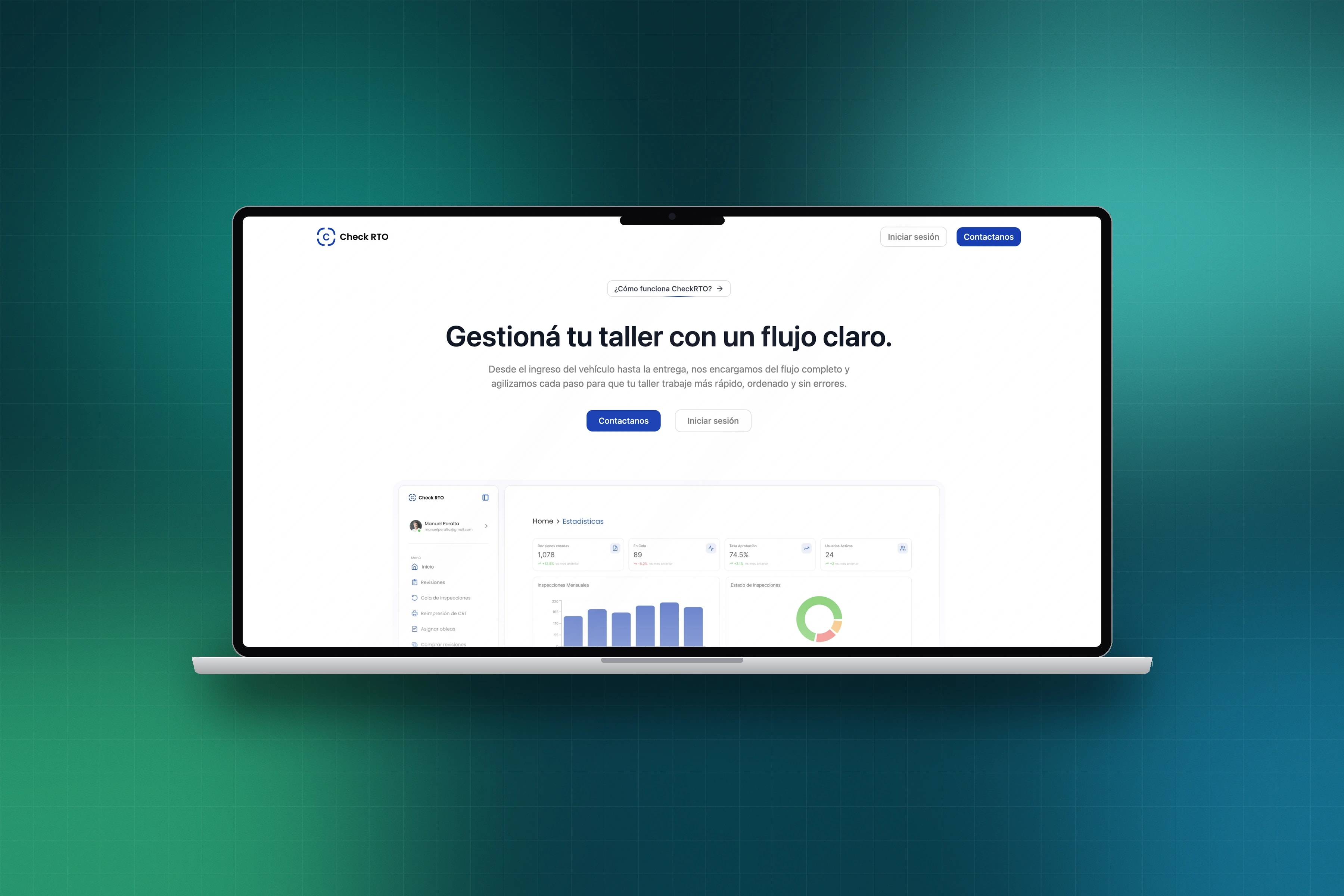
CheckRTO is a clear case. Mandatory vehicle inspections ran on paper forms, reports typed up again somewhere else and certificates issued through a separate process. No off-the-shelf tool knew what a technical inspection was. A custom platform now carries each inspection from intake to digital certificate as a single record.
The cost comparison people get wrong
SaaS looks cheaper because you compare a monthly fee with a one-time build. Compare three years instead, and include the hidden costs on both sides.
| SaaS | Custom software | |
|---|---|---|
| Upfront cost | Low or none | Medium to high |
| Monthly cost | Grows with users and features | Hosting and maintenance |
| Fit with your process | You adapt to the tool | The tool adapts to you |
| Integrations | Only those offered | Whatever you need |
| Data ownership | In the provider's system | Yours |
| Risk | Price increases, discontinued features | Depends on who builds and maintains it |
A subscription charged per user looks cheap with 5 users. With 40 users it costs eight times as much, every year, for software you will never own.
The middle path: SaaS plus a custom layer
You do not have to choose one. Many of the best setups use standard SaaS for the commodity parts (payments, email, accounting) and custom software for the core. In Kennedy's Group, the public site, the bookings and the Loggia backoffice are custom, because that is how a luxury villa business actually runs, while email delivery and geolocation run on proven services underneath.
Three questions to decide
- If a competitor used the same tool, would they work exactly like you? If yes, buy.
- How many hours per week does your team lose to workarounds? Multiply by a year.
- Is this software something you will sell, or something you will use? If you sell it, build it.
If after answering you are still unsure, let's talk it through. Sometimes the right answer is not to build anything, and we will tell you. When it is worth building, start with a focused MVP.
Frequently asked questions
Is custom software more expensive than SaaS?
Upfront, yes. Over three to five years it often is not, especially when the subscription is charged per user and the team grows, or when you pay for several tools to cover one process.
Who owns custom software?
You should. Before signing, make sure the contract states that the code, the repositories and the accounts are transferred to you when the project ends.
Can custom software integrate with the tools I already use?
Yes. Connecting to existing tools through their APIs is one of the most common reasons to build custom software in the first place.